
Workplace Relationships, Professional Ethics, and the Importance of Objectivity

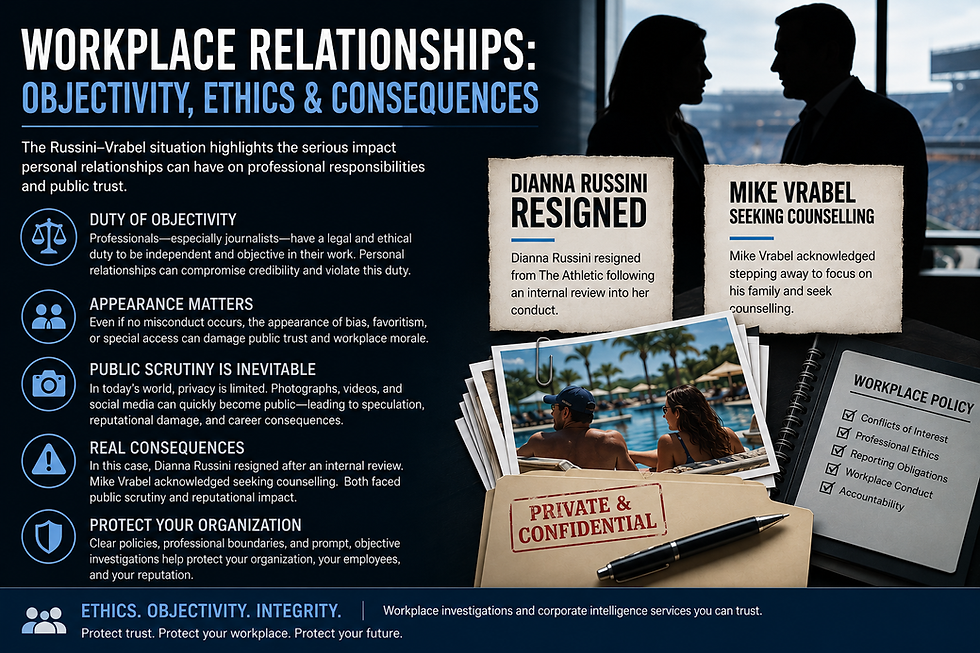
The recent public controversy involving Dianna Russini and Mike Vrabel has sparked widespread discussion regarding workplace relationships, professional ethics, media objectivity, and the consequences that can arise when personal relationships intersect with professional responsibilities.
While much of the public discussion surrounding the matter remains speculative, several facts have become publicly known. Russini resigned from The Athletic during an internal review into her conduct after photographs surfaced showing her and Vrabel together at a resort in Arizona. Vrabel later acknowledged stepping away temporarily to focus on his family and seek counselling following the controversy.
The situation highlights an important issue that extends far beyond professional sports and media organizations. Across corporate environments, law firms, government agencies, healthcare institutions, and private businesses, workplace relationships can create serious concerns involving objectivity, conflicts of interest, reputational damage, and public trust.
At Duncan Investigations, we witness firsthand how workplace investigations regularly involve allegations involving favoritism, conflicts of interest, breaches of professional ethics, abuse of authority, and inappropriate workplace conduct. In many cases, the greatest damage arises not simply from the relationship itself, but from the perception that professional objectivity may have been compromised.
The Importance of Professional Objectivity
One of the central concerns raised publicly in the Russini-Vrabel controversy involves the issue of journalistic objectivity.
As a senior NFL insider, Dianna Russini had a professional duty to maintain independence and objectivity while covering teams, executives, coaches, and league matters. Journalists are expected to avoid not only actual conflicts of interest, but also situations that may create the appearance of compromised reporting.
This principle exists because public trust is essential to journalism. When reporters develop close personal relationships with individuals they professionally cover, legitimate questions can arise regarding access, influence, preferential treatment, sourcing, and editorial independence. Even if no improper reporting occurred, the appearance of a conflict alone can damage credibility and public confidence. This is particularly significant in investigative journalism and insider reporting, where reporters often rely heavily on confidential sources and privileged access. The issue is not necessarily whether misconduct occurred. Rather, it is whether professional boundaries became blurred to the extent that public trust in the reporting process was undermined.
The fact that The Athletic reportedly initiated an internal review before Russini ultimately resigned demonstrates how seriously media organizations view these ethical concerns.
Workplace Relationships and the Appearance of Impropriety
In professional environments, appearances matter. Organizations across every industry recognize that even consensual relationships can create concerns regarding bias, favoritism, conflicts of interest, and compromised decision-making. This becomes especially important when one individual holds influence, authority, or insider access connected to the other person’s professional responsibilities.
In media organizations, the duty of objectivity is particularly important because journalists are expected to report independently without becoming personally involved with the subjects they cover.
In corporate environments, similar concerns arise when executives, supervisors, investigators, managers, or professionals enter into relationships that may affect neutrality or decision-making. Employees may begin questioning whether opportunities, information, or treatment are being distributed fairly. Once those concerns emerge, organizational trust can begin to deteriorate quickly.
The Role of Public Exposure and Surveillance
Another aspect that has generated significant discussion involves the photographs that triggered public scrutiny.
While there has been online speculation that the images may have been obtained through private investigative methods, there has been no confirmed public evidence establishing that a licensed private investigator was involved. Reports published afterward suggested the photographs may have been taken by other individuals at the resort rather than through a formal surveillance operation.
Nevertheless, the situation reflects an important modern reality: public figures and professionals increasingly operate in environments where privacy is extremely limited.
In today’s digital world, photographs, videos, social media activity, travel records, and public sightings can instantly become viral content. Executives, journalists, politicians, athletes, and professionals are routinely exposed to scrutiny that can rapidly escalate into public controversy.
For employers and organizations, this creates enormous reputational risk.
Even private conduct can become a workplace issue when it affects public confidence, professional credibility, or organizational integrity.
The Consequences of Workplace Relationships
The fallout surrounding the Russini-Vrabel situation demonstrates how quickly workplace relationships — or even the perception of inappropriate relationships — can create professional consequences.
In this case, the controversy reportedly resulted in:
A high-profile resignation from a major media organization;
Internal organizational reviews;
Significant online and media scrutiny;
Public reputational damage;
Questions regarding ethics and professional conduct; and
Personal consequences acknowledged publicly by those involved.
For corporations and employers, these situations serve as important reminders that workplace relationships can have far-reaching effects extending beyond the individuals directly involved.
Organizations must consider:
Conflicts of interest;
Ethical obligations;
Public perception;
Workplace morale;
Legal exposure;
Reputational risk; and
Whether professional objectivity has been compromised.
Why Workplace Policies Matter
Many organizations fail to address workplace relationships proactively until a crisis emerges. Unfortunately, by that point, the damage may already be significant.
Clear workplace policies regarding conflicts of interest, professional boundaries, reporting obligations, and ethical conduct are essential in modern organizations. Employees and leadership must understand that professional responsibilities do not disappear simply because a relationship is consensual.
The higher the position of influence or authority, the greater the expectation of accountability and professionalism.
In industries involving journalism, law enforcement, corporate governance, finance, investigations, or regulatory oversight, maintaining objectivity is critical to preserving public trust.
The Importance of Professional Workplace Investigations
When concerns arise involving conflicts of interest, ethical breaches, favoritism, or inappropriate workplace conduct, organizations must respond carefully and professionally.
At Duncan Investigations, workplace investigations are conducted objectively and confidentially to help organizations determine whether policies, ethical standards, or professional obligations have been violated.
The purpose of these investigations is not to interfere in personal lives. Rather, it is to protect organizational integrity, ensure accountability, and preserve confidence within the workplace.
In many cases, early intervention and professional investigative support can prevent situations from escalating into public crises.
Final Thoughts
The controversy involving Dianna Russini and Mike Vrabel has become more than simply a sports media story. It serves as a broader example of how workplace relationships and perceived conflicts of interest can create serious professional, ethical, and reputational consequences.
Regardless of the underlying facts, the situation demonstrates the importance of maintaining professional boundaries and protecting the appearance of objectivity in professional environments.
For journalists, corporate leaders, investigators, and professionals in positions of trust, credibility is often their most valuable asset. Once public confidence is damaged, rebuilding that trust can be extremely difficult.
In today’s environment, organizations cannot afford to ignore the importance of workplace ethics, objectivity, and professional accountability.



Comments